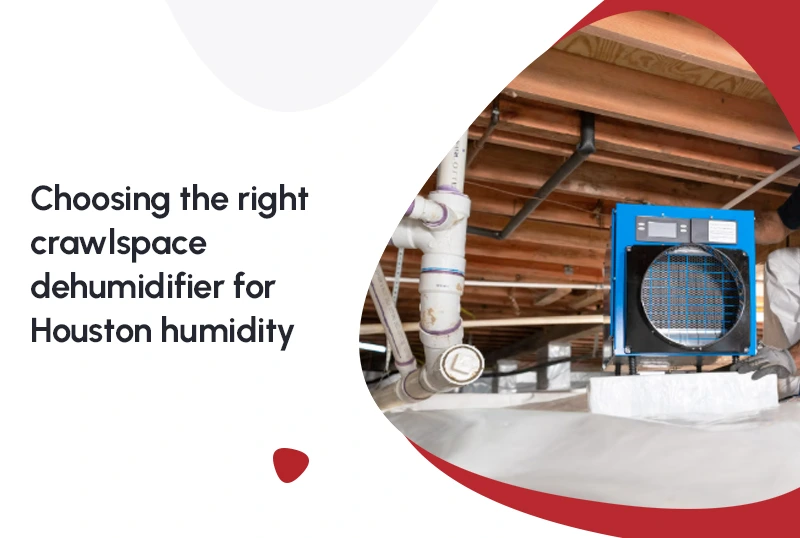
Houston’s hot and humid climate can present challenges for homeowners, particularly when it comes to maintaining a healthy and dry living environment. Among the most overlooked yet crucial areas in a home are crawlspaces, which can become breeding grounds for mold, mildew, and pests due to high moisture levels. The solution? A crawlspace dehumidifier. Crawlspace dehumidifier is a must-have for homeowners in Houston who want to combat humidity and ensure a safe, dry, and comfortable home. If you’re dealing with more severe foundation issues, such as those commonly seen with pier and beam foundations, you may need specialized pier and beam foundation repair in Tomball to fix the problem and protect your home’s integrity.
In this detailed guide, we’ll help you understand the importance of selecting the right crawlspace dehumidifier for Houston’s unique humidity challenges. We’ll cover everything from understanding the local climate and moisture issues to how to choose a dehumidifier that fits your home’s specific needs. By the end of this post, you’ll have all the knowledge needed to make an informed decision about the best crawlspace dehumidifier for your Houston home.
Why is a Crawlspace Dehumidifier Crucial for Houston Homes?
Houston’s climate is notorious for its humidity levels, which are often high year-round due to its proximity to the Gulf of Mexico. While the city experiences hot summers, the humidity in Houston can make the heat feel much more oppressive, and it can cause significant moisture problems within your home. Crawlspaces, in particular, are vulnerable to excess moisture and can quickly become damp and musty if not properly managed.
The moisture in a crawlspace can lead to several serious problems, including:
- Mold and Mildew Growth: Excess moisture promotes the growth of mold and mildew, which can damage wood and cause unpleasant odors. Mold can also affect indoor air quality and trigger respiratory issues, such as asthma or allergies.
- Wood Rot: Houston’s humidity can cause wood beams and joists to absorb excess moisture, leading to wood rot. This can weaken the structural integrity of your home, making repairs costly and time-consuming. In some cases, such moisture-related damage may require foundation repair in Tomball to address any long-term impacts on your home’s foundation.
- Increased Energy Bills: A damp crawlspace can increase the humidity in your home, making it feel warmer than it actually is. This results in overworking your air conditioning system, raising your electricity bills.
A crawlspace dehumidifier combats these issues by regulating the moisture level in the crawlspace, helping you prevent the potential damage caused by excessive humidity. But how do you choose the right crawlspace dehumidifier for Houston’s specific humidity challenges? Let’s break it down.
How to Choose the Right Crawlspace Dehumidifier for Houston
Selecting the right crawlspace dehumidifier for your Houston home isn’t a one-size-fits-all decision. It’s essential to take into account the size of your crawlspace, the moisture levels, and how much time and effort you’re willing to dedicate to maintenance. Here are the top factors to keep in mind when choosing a crawlspace dehumidifier for Houston humidity.
1. Capacity and Moisture Removal Power
The capacity of a crawlspace dehumidifier is one of the most critical factors in choosing the right unit. The larger the crawlspace, the higher the capacity you’ll need. A crawlspace dehumidifier’s capacity is typically measured by the number of pints of water it can remove per day. For Houston homes, a model that can remove at least 70 to 80 pints of moisture per day is a good starting point.
In humid regions like Houston, it’s often recommended to err on the side of choosing a higher capacity model. A dehumidifier with greater capacity can remove excess moisture faster, which is essential given how often Houston experiences high humidity levels.
- Small Crawlspaces (up to 1,500 sq. ft.): Look for a crawlspace dehumidifier that can remove about 50 to 70 pints of moisture daily.
- Medium Crawlspaces (1,500–2,500 sq. ft.): Choose a dehumidifier with 70 to 90 pints per day capacity.
- Large Crawlspaces (over 2,500 sq. ft.): A high-capacity model with 90 to 130 pints per day is best suited for larger areas with persistent humidity.
2. Energy Efficiency: Save on Utility Bills
Given that Houston’s humidity often requires a dehumidifier to run for extended periods, energy efficiency is another critical factor to consider. Energy-efficient models will save you money on electricity over time, ensuring that your crawlspace stays dry without inflating your utility bills.
Look for crawlspace dehumidifiers that are Energy Star certified. These units meet stringent energy efficiency standards and are designed to operate at lower power consumption while delivering maximum moisture removal.
Although energy-efficient models might come with a slightly higher upfront cost, they will pay off in the long run by reducing your energy bills, especially considering Houston’s high humidity levels throughout the year.
3. Automatic Drainage Options
Houston’s humidity requires a crawlspace dehumidifier to work efficiently and continuously for several hours or even days. For ease of use, choose a crawlspace dehumidifier that offers automatic drainage options. There are two common types of drainage systems:
- Gravity Drainage: This method works best if your crawlspace is sloped, allowing water to flow away naturally. Gravity drainage is a low-maintenance option, but it may not be suitable for all homes in Houston, especially those with flat or uneven crawlspaces.
- Built-In Pump: A dehumidifier with a built-in pump offers flexibility, as it can pump the water out to a distant drain or outside of your home. This option is ideal for Houston crawlspaces that do not have natural drainage systems or where gravity drainage is not possible.
The built-in pump feature ensures that the dehumidifier operates without requiring constant attention from you. This is particularly helpful in humid climates like Houston, where the need for continuous dehumidification is high.
4. Durability for Houston’s Harsh Climate
Humidity can wreak havoc on any mechanical system, and a crawlspace dehumidifier is no exception. When selecting a unit, make sure it’s made from high-quality, corrosion-resistant materials that can withstand constant exposure to moisture.
Look for dehumidifiers constructed with stainless steel components, rust-resistant metals, and durable plastic parts. These materials are designed to withstand the humid conditions common in Houston crawlspaces, ensuring the unit will last for years without deteriorating.
5. Convenience and Ease of Use
A good crawlspace dehumidifier should be user-friendly, especially since it may need to run for extended periods to combat Houston’s humidity. Many modern models come with smart controls and features like:
- Digital Controls and Humidistats: Humidistats allow the dehumidifier to automatically adjust based on the humidity levels in your crawlspace, saving energy while maintaining ideal moisture conditions.
- Automatic Restart: In the event of a power outage, this feature ensures that your dehumidifier resumes operation without requiring manual intervention.
- Low Noise: If your crawlspace is located near living spaces, you’ll want to ensure that the dehumidifier operates quietly, especially if it’s running 24/7.
Many dehumidifiers designed for crawlspaces are built with convenience in mind, so look for models that offer intuitive controls, easy maintenance, and a quiet, efficient operation.
How to Maintain Your Crawlspace Dehumidifier in Houston’s Humid Climate
While a crawlspace dehumidifier is a key tool for keeping your crawlspace dry, it’s also essential to monitor your home’s foundation for any signs of stress caused by Houston’s humid conditions. Over time, excess moisture can seep into your home’s foundation, leading to uneven settling and structural issues.
In situations where moisture has caused foundation problems, house leveling in Tomball may be required to restore your home’s balance and stability. By addressing both your crawlspace moisture levels and foundation health simultaneously, you can prevent long-term damage and ensure your home remains solid and secure.
Conclusion
Choosing the right crawlspace dehumidifier for your Houston home is crucial to preventing mold, mildew, and wood rot, which thrive in the city’s humid environment. By considering the size of your crawlspace, moisture levels, energy efficiency, and maintenance requirements, you can select a unit that will keep your home healthy, safe, and dry year-round. A guide from PNNL on flood‑resistant crawlspace foundations highlights that in humid or flood‑prone regions, a properly managed crawlspace with dehumidifier and drainage can protect against foundation damage.
A crawlspace dehumidifier is more than just an appliance—it’s an investment in the longevity of your home. With Houston’s humidity constantly challenging homeowners, the right dehumidifier will not only protect your property but also save you money in the long run by reducing energy costs and preventing expensive repairs.
FAQs
1. Is it worth putting a dehumidifier in a crawl space?
Yes — in many cases it is worthwhile. A crawl space dehumidifier helps reduce humidity, which in turn prevents wood rot, mold, pest infestations, and musty odor from seeping into the rest of the house. One source notes that moisture from a crawl space can affect air quality upstairs, because “up to 40% of the air on the first floor of your home originates in your crawl space.”
However, the effectiveness depends on how well the crawl space is sealed or prepared. If the space is wide open, ventilated, or poorly isolated, the dehumidifier will work harder and may not fully control moisture.
So: yes — it’s worth it when you have persistent moisture issues, but it’s less effective when conditions are poor and you haven’t addressed underlying issues.
2. How much does it cost to put a dehumidifier in your crawl space?
Costs vary widely based on unit size, installation complexity, and whether additional work (such as encapsulation) is required. Some estimates show:
- For unit purchase in a well‑sealed crawl space: around $1,500–$2,800 installed.
- When combined with full encapsulation, or if crawl space is large and difficult to access: average around $3,000–$9,200, with an average of about $7,000 in one report.
- Units alone (online listings) can start around $1,300–$2,000+ for crawl‑space specific dehumidifiers.
So you can budget from a few thousand to nearly ten thousand dollars depending on conditions.
3. Can you put a dehumidifier in a crawl space without encapsulation?
Yes — you can, but there are caveats. According to sources:
- A dehumidifier can operate in an unencapsulated crawl space, but because the space remains exposed to outside air, ground moisture, and fluctuating conditions, the unit will have to work harder and may struggle to reach stable humidity levels.
- One expert commentary states: “the dehumidifier will have little to no effect in an unencapsulated crawl space because there is too much infiltration.”
So technically yes, but for best results you should at least prepare the space (seal vents, install vapor barrier) so the dehumidifier is effective.
4. What kind of dehumidifier do I need for a crawl space?
You should look for a dehumidifier that meets these criteria:
- Crawl‑space rated (low clearance, designed for cooler temperatures and high humidity)
- Sufficient capacity: units are often rated by “pints removed per day” or by square footage. For larger or less sealed crawl spaces you’ll want higher capacity models.
- Drainage capability: many units include automatic drain or pump so you don’t have to manually empty collection tanks.
- Durable for cooler conditions: if the crawl space is unconditioned, ensure the unit can operate at lower temps without icing.
- Optionally: dehumidifiers that integrate with encapsulation systems or are designed to work in tandem.
In short: get a model specifically meant for crawl spaces, sized appropriately, and with proper drainage and operation range.
5. Does my crawlspace need a dehumidifier?
You should strongly consider one if you have any of the following:
- Frequent dampness, condensation, musty odor, or visible mold growth in the crawl space.
- Storage items in the crawl space being damaged by moisture.
- Wood joists or beams showing signs of rot or high humidity.
- The crawl space is used as a part of the HVAC / mechanical space so humidity might impact the rest of the house.
If you have none of these and the crawl space is dry, well‑ventilated, and sealed, you might manage without, but it’s often a proactive measure that pays off.
6. How much does it cost to have a dehumidifier installed in a crawl space?
As above, installation cost depends on setup complexity: small unit only = possibly $1,000–$2,000+; full install with preparation may be $3,000–$9,000+.
This includes the unit, labor, possible ducting or drainage changes, and possibly additional equipment (like pump or controls).
Ensure your quote includes labor, installation of drain line or pump, electrical hookup, and any crawl space preparation.
7. How do I prepare my crawl space for a dehumidifier?
Good preparation steps include:
- Seal off bulk water entry points and fix drainage issues around the foundation (downspouts, grading).
- If possible install a ground vapor barrier or floor cover to reduce moisture coming up from the soil.
- Seal vents and openings to reduce air infiltration from outside.
- Ensure proper drainage for the dehumidifier so the water it removes is carried away safely (not just pooling).
- Remove any visible mold or wood rot and ensure the joists/beams are in sound condition.
- Choose the correct size unit for the space (based on square footage and expected moisture load).
- Provide access space for maintenance and ensure electrical supply is adequate.
Following these steps will help the dehumidifier work more effectively and last longer.